Jericho · how it plays
A role-playing game you play by walking. Every step feeds a character who levels up, grows stronger, learns to fight, and carries a card you can show your friends. Put the phone in your pocket and go somewhere — the game is already playing.
01 — the engine
There is no other fuel. Steps become experience, and experience becomes levels. Steps become energy, and energy is what a fight costs. The energy escalates — a step past 15,000 is worth two and a half times a step at breakfast, so the reward lands exactly when you are deciding whether to keep going.
Every step counts, up to 30,000 a day. There is no dead zone in the middle of a long walk — and there is a ceiling at the top of one, deliberately, because a game with no ceiling is a game somebody gets hurt chasing.
| From | Your character is |
|---|---|
| 0 | walking |
| 5,000 | running |
| 10,000 | on guard, weapon drawn |
| 15,000 | charging a strike |
| 20,000 | mid-ultimate — the pose only heavy walkers ever see |
Alongside it runs the day's star ladder — silver at 5,000, gold at 10,000, then rare, epic and legendary at 15,000, 20,000 and 25,000. Stars are kept per day, so the calendar becomes a record of the walking rather than a streak you can break.
02 — combat
One attack power against one wall of defence, and what gets through is a share rather than a subtraction:
damage = power × (power ÷ (power + their defence))
So a turn is never wasted — whatever you throw lands for something, and a stronger blow punches through a heavy guard rather than bouncing off it. The skill is in what you spend and when: which move to hold for the opening, what to keep mana for, and when to stop swinging and brace instead — which deals nothing at all and takes most of the force out of whatever lands on you.
You choose, your opponent chooses, and both moves land together — monsters included. Anything else would hand whoever moves second an answer, and a live duel between two people cannot work that way. The interface shows you the wall you are hitting, never the button to press.
Each class has seven moves and you carry four into a fight, chosen before it starts. In the duel every skill sits on a bar with its cost and cooldown showing, and one tap spends the turn — so you can plan the next move while watching this one land.
03 — the roster
Every class starts on the same stat total at every level — only the split differs, and a test in the codebase fails if that ever stops being true. No class is a trap and none is the correct answer; they are four different shapes of fight.
StrikerMasculine
StrikerFeminine
InfiltratorMasculine
InfiltratorFeminine
BulwarkMasculine
BulwarkFeminine
AdeptMasculine
AdeptFeminineEach is hand-drawn in both a masculine and a feminine presentation, across eleven poses — idle, walking, running, on guard, charging, a quick strike, a strong attack, a block, an ultimate, a victory and a defeat. That is 88 figures before a single monster is drawn.
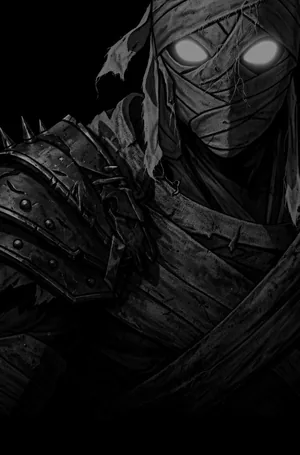
Ten creatures, each met a second time as an elder in armour it did not have the first time — twenty rungs up to level 100, ending on The Boss.
Hollow Strider
Mire Hound
Ashen Golem
Carrion Wing
Mirefang Broodmother
Cinder Warden
Tide Chorus
Gilded Tyrant
Void Herald
Storm Sovereign04 — the card
Your character is a physical trading card — dark stone stock, a printed face, rounded corners, a keyline in your rank's colour, and a shadow that lifts it off the screen.
| Rank | Reach | Then walk | The card becomes |
|---|---|---|---|
| Sergeant | level 1 | — | the app's own blue |
| Lieutenant | level 10 | 20,000 steps in one day | cold cyan |
| Captain | level 30 | 25,000 in one day | gold |
| Major | level 60 | 30,000 in one day | violet |
| General | level 100 | 30,000 on two days running | red |
Reaching the level only makes a rank eligible. One enormous day is what actually spends it (two in a row, for General). And once you have held a rank you keep its colours — every rung you have climbed stays selectable, so promotion is a wardrobe rather than a replacement.
The ask stops climbing at 30,000, and that is deliberate. The top two ranks want the same distance; General asks for it on two days running, and level 100, instead of a longer walk. This is a health game before it is an engagement game, and a ladder that keeps asking for more is the one mechanic here that could push somebody too far.
05 — what you wear
The ground your card is printed on. A new hero's plain card is an empty slot, with nothing on it to upgrade. One background is lit by your rank, so the same cracked stone burns cyan for a Lieutenant and red for a General — a reward for beta testers, won by reaching level 2 and walking a 5,000-step day during the beta. Another is won at level 7 with one 15,000-step day. At level 50 you are handed your own class portrait, drained to greyscale, to stand in front of — the only background that is different for every player, because it is a picture of you.
What you fight in. A free ladder: you start in plain travelling clothes, the Wayfarer Garb, which carry no stats. At level 20 a 20,000-step day wins the Ranger's Longcoat, and at level 40 another 20,000-step day wins the Longstrider's Mantle. Both are drawn in full, every class and pose. A costume changes the drawing of your character, not a badge on it.
06 — the promise
This is enforced in code rather than in a paragraph.
Energy cannot be bought at any price — not a purchase, not a bundle, not a starter pack. If fighting could fund itself, the step counter would stop gating anything.
A paid costume and a found one are worth exactly the same stats. Free and paid read the same shared constant, and an automated test fails if anyone tries to change that.
The colour your card wears is only ever earned by walking. What money buys is a look, and a change of class. That is the list.
The game is friends duelling friends. A friend who paid beating a friend who walked would end it.
07 — one clock
The day turns over at midnight GMT+8, for every player on earth. That sounds like a detail and is not: a day that begins at a different moment on each phone cannot be compared, and comparison is the entire point of what comes next. If you are somewhere else, the app tells you what time your day resets on your own clock, and whether that falls today or tomorrow where you are.
08 — your data
Step counts are health data and are treated that way. Your hero lives on your account, so your daily totals and hero back up to our server, which is also how the game stays fair: energy, rewards and duels are worked out from the steps the server has banked. Other players see your steps only if you agree, and it is never raw samples and never for advertising. The privacy policy lists everything we store.
An open beta on iPhone and Android, reading real step data from Apple Health and Health Connect — so steps you took with the app closed are credited the next time you open it, up to three days back — and laid out for a folding phone in all four of its shapes. In it now: the walking engine with energy and the daily star ladder, four classes across 88 hand-drawn figures, seven skills per class, the hero card with its ranks, a creature ladder of twenty rungs to level 100, quests and daily errands, a shop, a bag, and gear in five tiers, from Standard to Legendary, whose upgrades never fail and stay with the piece. Your hero lives on your Apple or Google account, one phone at a time, and with it come friends, guilds with titles and wars, live friend and ranked duels, practice spars, invite links and the inbox. Get it from the beta page.
Nothing can be bought: premium looks are coming, and the one premium costume is partly drawn and not for sale. Challenges reach an offline friend only through the in-app inbox — there are no push notifications — and duels have no seasons yet.
Friends, duels and guilds
You sign in with Apple or Google before you make a hero, and that account is where your friends, your guild and your duels live. It is built for people who know each other, not anonymous leaderboards.
Duel a friend, live
See which friends are online, send a challenge, and fight them there and then — your character against theirs, the gear you both walked for, the four skills you each chose. Turn for turn, against the actual person rather than a copy of them. A friend who is offline finds the challenge in their inbox.
Or find a ranked match
Join the queue and you are paired with somebody near your rating and your strength. Friend duels are for fun; ranked ones move your rating, and the ranked board sorts everyone with a result into coloured brackets, from blue up to red for the very top.
A duel is played for the rating, and nothing else
No coins, no loot, no experience, and nothing lost by whoever loses. Walking is the only thing in this game that makes you stronger, and a duel that paid would quietly become a better way to get ahead than going outside. And the server runs every fight on stats it works out itself from the steps it has banked, so an edited phone cannot win one.
Guilds and guild wars
A guild is a group of friends, led by a Guild Master, with a Guild Commander to succeed them and officers beside them. A war pairs two of them for 48 hours, with a day's warning first — because knowing a long walk is coming is what makes people plan one. Both sides field the same number, in fives, and joining is your own choice: set yourself in or out, so a week of travel or illness never means letting your guild down.
Every step counts
A guild's score is every fielded member's steps over the two days, added up. Each person counts up to 30,000 a day, the same limit as everywhere else, so nobody is worth more than 60,000 and one marathon walker cannot carry a war alone. Every step anybody on the roster walks moves the score.
Bring a full party
Each complete set of all four classes among the fielded members adds 5% to the score, up to five sets. Level scores go to the guild with more sets. So the strongest walkers are not automatically the best roster to field — a decision your guild gets to argue about before the war starts.
Friends and the inbox
Friends are added by request and accepted by the other side. The inbox carries friend requests, duel challenges and gifts, and your friends appear as their actual hero cards rather than a list of names.
Bring someone new
Share your invite code. When the newcomer has walked 10,000 steps from their second day, you both get 300 coins — paid for walking, not for signing up.